The All-in-One Answer: A Tribute to Amstrad Computers
If the Commodore 64 defined the American living room and the BBC Micro owned the British classroom, Amstrad provided the defining all-in-one solution for the pragmatic British small business and home user. Championed by the charismatic Alan Sugar, Amstrad (Alan Michael Sugar TRADing) didn’t necessarily aim to beat its rivals on pure technical specifications; it sought to dominate the market on value, integration, and simplicity.
The defining Amstrad philosophy was plug and play. Instead of a rat’s nest of power bricks and video cables, Amstrad sold complete solutions: a computer, a monitor, and a built-in storage device (tape or disk), all powered by a single plug from the wall.
The Amstrad CPC (short for Colour Personal Computer) is a series of 8-bit home computers produced by Amstrad between 1984 and 1990. It was designed to compete in the mid-1980s home computer market dominated by the Commodore 64 and the ZX Spectrum. Successfully establishing itself primarily in the United Kingdom, France, Spain, and the German-speaking parts of Europe.
The series spawned a total of six distinct models: The CPC 464, CPC 664, and CPC 6128 were highly successful competitors in the European home computer market. The later 464plus and 6128plus, intended to prolong the system’s lifecycle with hardware updates, were considerably less successful. As was the attempt to repackage the plus hardware into a game console as the GX4000.
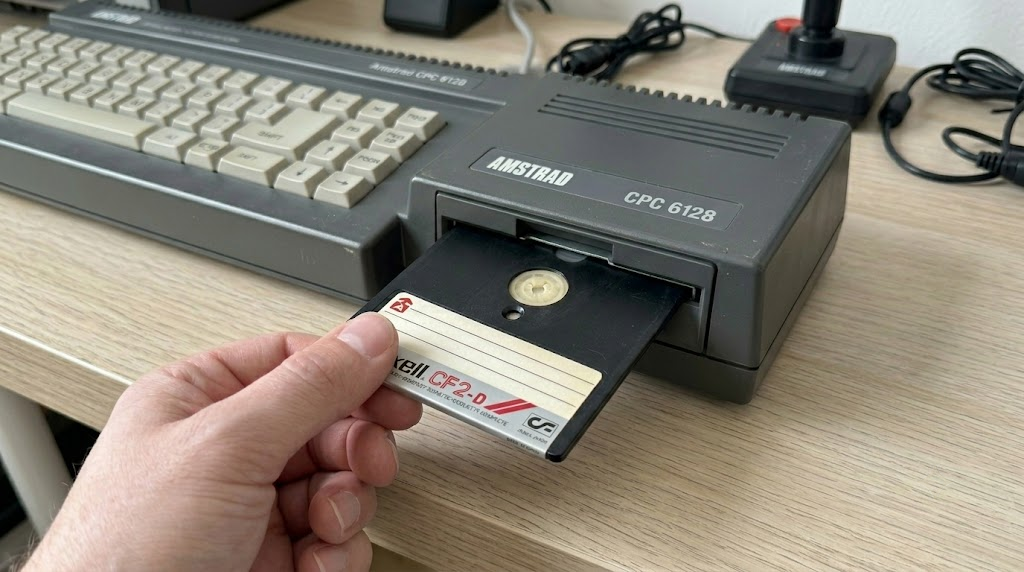
The CPC models’ hardware is based on the Zilog Z80A CPU, complemented with either 64 or 128 KB of RAM. Their computer-in-a-keyboard design prominently features an integrated storage device, either a compact cassette deck or 3-inch floppy disk drive. The main units were only sold bundled with either a colour, green-screen or monochrome monitor that doubles as the main unit’s power supply. Additionally, a wide range of first and third-party hardware extensions such as external disk drives, printers, and memory extensions, were available.
The CPC series was pitched against other home computers primarily used to play video games and enjoyed a strong supply of game software. The comparatively low price for a complete computer system with a dedicated monitor, its high-resolution monochrome text and graphic capabilities, and the possibility to run CP/M software also rendered the system attractive for business users, which was reflected by a wide selection of application software.
During its lifetime, the CPC series sold approximately three million units.
The CPC 464: Instant Computing, Instant Success
 Launched in 1984, the Amstrad CPC 464 was an immediate smash hit. Amstrad recognized that many potential computer buyers were intimidated by the complexity of rival systems. The CPC 464 was their answer.
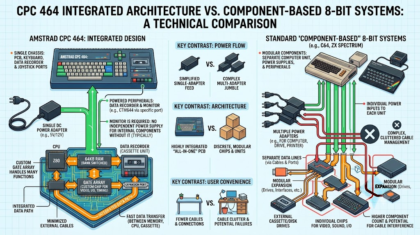
The Integrated Solution: It shipped with a monitor (either monochrome green or a budget colour display). Critically, the computer’s single power lead plugged into the monitor, which housed the main transformer.
The Built-in Datasette: Amstrad integrated the tape deck directly into the main keyboard unit. There were no proprietary tape cables to lose or align.
The Snappy CPC BASIC: Running on the ubiquitous Zilog Z80A at 4MHz, the CPC featured a powerful, structured Locomotive BASIC that was easy to learn and encouraged clean programming.
The Expansion: Disks, Colours, and the PCW
Amstrad didn’t stop with the tape-based CPC. They quickly expanded the line-up:
CPC 664 & 6128 (1985): The crucial evolution. These systems replaced the datasette with an integrated, high-speed 3-inch floppy disk drive. The CPC 6128, with its 128K RAM, became a serious business tool, running CP/M software in addition to CPC games.
PCW 8256/8512 (1985): A radical departure. The PCW (Personal Computer Wordprocessor) was a specialized machine marketed solely as a dedicated word processing solution. It included the ‘LocoScript’ software and a complete printer. For many small British businesses and writers, the PCW was their first computer.
The 3-Inch Disk Drive: While the rest of the 8-bit world adopted 3.5″ disks, Amstrad stubbornly standardized on the rigid, double-sided 3-inch compact floppy. These disks were more durable than 5.25″ disks, but became a proprietary (and expensive) quirk of the Amstrad ecosystem.
The PC-Compatible Era: Dominating the Business Desktop
Acorn Computers had focused on RISC and ARM, but Amstrad saw the market shifting toward IBM PC compatibility. They leveraged their “all-in-one” concept to democratize the business PC market in the UK and Europe.
PC1512 / PC1640 (1986): These systems revolutionized the cheap PC clone market. They were high-quality, fully integrated IBM PC compatibles that included CGA graphics, a built-in mouse, and ran MS-DOS 3.2. Their affordable price point put a powerful PC on thousands of British desktops that couldn’t justify the cost of an original IBM machine.
The Sinclair Purchase (1986): Amstrad famously purchased rival Sinclair Research’s computer assets. While this gave Amstrad the rights to the ZX Spectrum range, it also secured them Sinclair’s radical PC200 design. The resulting Amstrad PC200 was an attempt at an “all-in-one” 8086-based PC clone that utilized a television for a display, though it saw limited commercial success.
The Software That Defined the Platform
While often marketed as business tools, the Amstrad computers (especially the CPC range) were fantastic gaming machines, inheriting a massive library from the Z80-compatible ZX Spectrum and developing unique exclusives.
Harrier Attack (CPC): A fast, action-packed vector graphics flight simulator that became an early definitive game for the platform.
Gryzor (CPC): A technically impressive, faithful conversion of the arcade classic Contra, proving the CPC could handle intense, action-oriented titles.
LocoScript (PCW): Not a game, but the killer application that sold the PCW. For thousands of people, LocoScript was word processing in the 1980s.
CPM 2.2 / CP/M Plus (CPC 6128/PCW): The powerful business operating system (preceding MS-DOS) that gave the Amstrad disk systems access to a massive library of professional applications.
The “Single Box” Advantage: The Power Integration
The true secret to Amstrad’s success was the engineering simplicity of its power integration. In rival systems, you had a rat’s nest of power bricks. The CPC put the transformer inside the monitor housing. The computer itself was powered by the monitor. This design wasn’t just tidy; it meant Amstrad could sell the system as a single, dependable, high-value unit.
Service Your CPC
Keep your CPC 464 or 6128 running smoothly with our selection of drive belts, monitor cables, and logic chips. Check out our Amstrad Repair Kits to ensure your system stays pixel-perfect!